I am so pleased to be hosting a stop on the Tangletree Mysteries blog tour. I loved exploring Tangletree Mysteries: Peggy and Stu Investigate, a fun and vibrant graphic novel. Tangletree Mysteries was released in July 2023, written and illustrated by Steve Roberts and Joel Stewart and published by Welbeck Children’s Books.
About the book
Tangletree Mysteries are fun and vibrant graphic novels that will appeal to early readers and avid mystery seekers. I love the fun nature of these books. They are easy to read and presented beautifully. They will appeal and engage a variety of readers. It reminded me of when I loved reading comic books when I was young.
Tangletree Myteries are short stories about a dog: Peggy. When out on his daily walk chasing his ball, Peggy ends up venturing into Tangletree Forrest, which is like a portal into another world. A world where he is a master investigator amongst the community of enigmatic animals. Each book has two Mysteries.
The first story in Peggy and Stu Investigate involves a stench in Tangleetree and the residents are mysteriously falling asleep on their feet! It falls down to Peggy to solve the mystery with his sidekick Stu. Stu is not the most reliable or helpful sidekick in this story, but they work together to solve the mystery and Peggy returns from his adventures to resume his walk.
The second story involves a tough mudder course gone wrong that puts the competitive residents in Tangletree in danger. Peggy and Stu must once again work together to reval the culprit and return Tangletree to its former harmony.
Fun illustrations bring this story to life and will entice and engage a variety of readers.
Tangletree Mysteries by Steve Roberts and Joel Stewart, published by Welbeck Children’s Books, July 2023 5+ years.
Don’t forget to check out the other stops on the tour!
Thank you for inviting me on this tour, Antonia Wilkinson.
I am so pleased to be hosting a stop on the Chasing the Shy Town blog tour. I loved the fun nature of Chasing the Shy Town,which encapsulates the innocence of children’s natural curiosity and delves into the impossibility of perfection in a child friendly way. Chasing the Shy Town was released in June 2024, written by Erika Mcgann, illustrated by Toni Galmés and published by Little Island Books.
From the author
For All Ages
At any one time I’m usually working on several books, each aimed at a different age level. Right now I’m writing a fantasy novel for middle grade readers, a picture book for younger kids, and I’m dipping in and out of a young adult horror. It works well for me, because every reading level has its own challenges; it’s as though each one works a different set of muscles, and when I’ve exhausted one set, I take a break by working on another.
My first book, The Demon Notebook, was for middle grade readers. I felt confident writing for that age group – I figured every children’s author has a particular reading level that comes naturally to them, and this was mine.
I wrote a number of books in that series, and afterwards I really wanted to have a go at writing for other age groups, but the thought of going up or down in reading level was intimidating. Picture books in particular were a mystery to me. I could only ever see the wonder in a picture book story once it was fully illustrated. I found the manuscript on its own too abstract to tell.
Then I took a freelance job writing stories for schoolbooks. With one-line prompts, I had to churn out a story a day, and each one had a required reading level measurement. I had to plug my story into a program, and the program spat out a number. If the number was too high or too low, I had to amend the text. It was a baptism of fire, but I learned a lot. Over months I became more intuitive about reading levels, and not long after finishing the job I wrote my first picture book.
My new book, Chasing the Shy Town, is aimed at 4-8 year olds. It’s about a young boy named Senan who has no desire for adventure. But when he spots the Shy Town – a hilltop town that vanishes and reappears along the horizon – his fearless best friend and no-nonsense grandmother drag him along on an epic adventure to find it. I had thought the book would be for middle grade readers – I had written two standalone books before it, and felt this would make the third in a kind of pseudo-series – but I couldn’t seem to get going on the story. I rewrote the opening chapters again and again, but it just didn’t work. Frustrated, I took a break. When I came back to the book I threw the text out and started from scratch. Within the first few paragraphs I realised I had lowered the reading level. All of a sudden the book took off, nearly writing itself. It was another great lesson, and something I’ll be aware of in future – that rather than trying to force a particular reading level, I should relax and let the story choose its own audience.
Learning how to write for different age groups was not easy, but I’m beyond happy I did it. My work is constantly changing – there is always something to be excited about, and always a new challenge to face.
About the book
‘…tickly feeling in his tummy like he’d swallowed a bucketful of butterflies.’
Chasing the Shy Town
Senan doesn’t care for adventure. He’d rather watch the world go by from his bedroom window.
But when he spots the Shy Town – a hilltop town that vanishes and reappears along the horizon – he is fascinated.
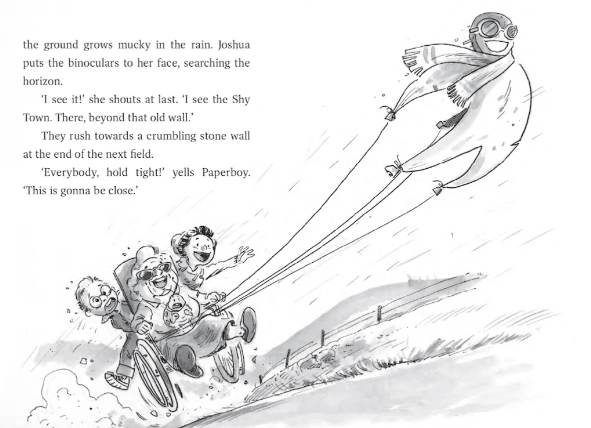
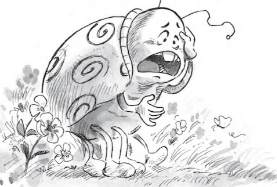
Along with his fearless and fun-loving neighbour and his no-nonsense grandmother, Senan sets out to find the Shy Town. On their epic adventure they encounter wild storms, a boy made of paper, a nervous, beetle-like creature with remarkable abilities – and a mysterious town with an incredible secret.
Brushstroke illustrations by Toni Galmés really bring this story to life.
About the author
Erika McGann is an award-winning children’s author based in Dublin. She has written a wide range of children’s books, including Where Are You Puffling? (with illustrator Gerry Daly) and Tabitha Plimtock and the Edge of the World (with illustrations by Phillip Cullen), which was awarded a White Raven by the International Youth Library.
About the Illustrator
Toni has always liked to tell stories through his drawings. Toni was born in Mallorca, a sunny Mediterranean island. Later he moved to Barcelona to study Fine Arts. There he learned, read, and worked as a storyboard artist for film and advertising. He fell in love with a bookseller and, from that love, his work as an illustrator of children’s books and graphic novels was born. Toni’s work includes picture books, novels and graphic novels published in Spain and France, with publishers such as Penguin Random House, La Galera, Bindi Books and the prestigious Franco- Belgian comic publishers, Dupuis and Delcourt.
Chasing the Shy Town by Erika McGann, illustrated by Toni Galmés and published by Little Island Books, June 2024 6-9 years.
Don’t forget to check out the other stops on the #ChasingTheShyTown
Thank you for inviting me on this tour, Antonia Wilkinson.
Fluency means “flowing freely” therefore reading fluency is the art of reading aloud, so that it ‘flows’ naturally for the speaker. It is important to note that reading fluency is one aspect (of many) that contributes to affluent readers.
Reading fluency entails the combination and reciprocation of word reading with accuracy, automaticity and prosody. That is reading the words on a page correctly without reliance on decoding, with the correct intonation, expression, pace, volume etc in order to draw from and convey meaning.
In order for children to begin to understand what they have read, they first need a solid understanding of our language – the printed code of our spoken language. They need to have had enough time learning and practising decoding to map (orthography) words they can then recognise accurately and automatically. This is NOT learning sight words, but rather recognising the words and being able to accurately retrieve and say them.
Once children are able to read at around 90 words per minute, they are no longer working so hard to decode the words on the page, this frees up their working memory to think about how the words fit into the wider text. That is to understand what they have read (comprehension). When children are at this stage, they have the key that unlocks the world to them. They are able to read for pleasure, read for knowledge and read for fluency.
No child should leave school not being able to read
Reading with prosody is an area that also demands focus. If I read a poem in a dull, monotone voice regardless of punctuation – it wouldn’t engage the listener. Reading prosody is the elements that combine to transport listeners back to folklore storytelling by campfires. It is the build up, the excitement, the music in movies where you know something is going to happen. Speeches, debates and poems lend themselves really well to prosody practice because they are designed to be read aloud. It is important to teach children that all texts are not equal and are not read in the same manner. You wouldn’t read Michael Rosen’s Chocolate Cake poem in the same manner as a news broadcaster would read the latest breaking news.
Modelling metacognitive strategies aloud when reading to a class is also vital to support skilled readers. These include modelling ‘drifting off’ and the need to reread a part of a text to ensure that you understand the meaning, summarising each paragraph (more so in non-fiction) to aid memory and understanding and ‘thinking aloud’: I don’t know what that word means, it sounds like, so I wonder….
For a more in-depth, research driven conversation on reading fluency, I highly recommend that you check out the THINKING DEEPLY ABOUT PRIMARY EDUCATION podcast: Reading Fluency?
There are many ways to facilitate fluency in the classroom; modelling and discussing what prosodic reading is comes first and foremost, followed by paired reading, echo reading and repeated reading with a wide variety of texts.
Shanahan suggests that you (flexibly) pair readers up by mixed-ability on a rotational basis. Each pupil reads a paragraph and repeats it at least three times with their partner following and providing feedback and then they swap. The pupils should be able to read the text fluently by the end of the lesson. Read the full blog here.
If kids aren’t reading the text fluently by the end of the lesson, then the lesson itself is ineffective.
Shanahan on Literacy: Teach How To Teach Fluency So That It Takes
Shanahan suggests that selecting a text whereby children make ten mistakes in every hundred words is pitched at the right level. If they can read the text already, it isn’t a fluency lesson.
In my setting, we use a lot of my turn, your turn for a variety of reasons. Chris Such posed an interesting caveat that pupils may ‘seem’ like they are following along, but are actually just repeating what you have said. He suggests, along with Shanahan that paired reading is a more accurate way to assess reading fluency. You can find that conversation here. Shanahan only suggests modelling part of the text or if children are really struggling with it.
A Y3 fluency activity based on a previous chapter read from Planet Omar
The Megabook of Fluency by Rasinski and Smith also has an abundance of activities designed to facilitate reading fluency and is worth a look.
Reading fluency is one of the many key strands that when woven together results in skilled reading. I really like the Scarborough reading rope to depict this. Our active ingredients for reading were born from the key strands, but with some additions. Our active ingredients show what each teacher needs to be doing in order to teach reading well.
There is a wealth of research out there for reading and these are just some of my thoughts on one part that makes for skilled reading.
I am so pleased to be hosting a stop on the Wolfbane blog tour. I was enraptured from cover to cover the minute I received my copy. This is pure escapism at its peak!
Prepare for an unimaginable adventure like no other. Michelle Paver writes with flair, bringing her hands-on experience and passion to transport you back to the Stone Age. Paver writes with raw, intimate knowledge. It is as if you have been immersed into fierce tribal communities designed to protect each other whilst upholding their traditions, living as one with the land and hunting to ensure survival for future generations.
Wolfbane is the epic-adventure-fuelled finale in the multi-million copy selling series that started with Wolf Brother by author: Michelle Paver.
This is the birth of story and legend-telling, so settle down, snuggle up and get ready for the epic adventure that unfolds.
About the book
‘A howl rose in Wolf’s throat. It ended with a whimper.’
The ancient clans seek peace, but at what cost? A choked howl gives way to a deafening silence that echoes around the forest. Pack brother and expert tracker, Torak and his mage mate, terrific shot with a bow and arrow, Renn answers the call, but will they be too late? An ice demon on the hunt, for one soul – Wolf’s. Spring is near. The ice is starting to melt. Will Torak and Renn be able to save Wolf in time?
Wolfbane is the final in the best-selling, award-winning series that started with Wolf Brother. Michelle Paver draws the reader into an immersive page-turning stone-age inspired fantasy world. Separated from his pack, Wolf is stranded on an iceberg floating far away from home and safety. Renn and Torak plan a rescue, but it is fraught with peril at every turn. They must defeat the ice demon once and for all, but at what cost? Slaying the demon would result in an eternity of being outcasts: from each other and their clan.
Full of unexpected twists: Wolfbane inhales the reader into a fast-paced adventure with themes of friendship, belonging and survival entwined with nature.
About the author
Michelle Paver is an international bestselling author. Born in Malawi, arriving in England as a child. She studied biochemistry at Oxford University, before becoming a partner in a City of London law firm. After her father’s death she turned to writing and has never looked back.
Michelle is known for her meticulous, hands on research, which is what enables her to write immersive, pure escapism. She has explored ice caves, swum with killer whales, tracked musk-oxen and crawled into a grizzly bear’s den. What her characters do, she does first!
Michelle talks of the weird food that she has eaten in the name of research including whale skin, dried herring roe on kelp, fresh octopus ink and raw seal liver.
Thank you for joining my stop on the Let’s Go Outside blog tour!
What better time than spring is there to be shouting LET’S GO OUTSIDE!!
Picture books play a vital role in children’s lives from a young age in teaching them about the world around them and how they fit into it through fun rhymes, colourful images and through fuelling their curiosity.
What I really love about this book are the discussion prompts and activity suggestions included at the back of the book, eliciting screams of LET’S GO OUTSIDE!
‘Let’s go outside! Let’s run as fast as our legs can carry us. Let’s make the best den in the whole wide world.’
About the book
Join a group of friends as they play together throughout the year in this joyful celebration of spending time outside every day.
The great outdoors is waiting, ready to be filled with excitement and imagination. Explore the fun that can be had outdoors in all weathers and across the globe and count how many children have gone outside to play in this joyful celebration of imaginative play and the simple pleasure of spending time outside everyday… and cosying up indoors at the end of the day.
At the end of this simple and lyrical non-fiction picture book are discussion prompts and outdoor activity suggestions, all ready for parents, carers, and children to say: LET’S GO OUTSIDE!
Meet the author: Ben Lerwill
Ben Lerwill is a multi-award-winning travel writer based in Oxford. He has written for publications and websites including national newspapers, Rough Guides, National Geographic Traveller, and many more. His children’s books include WildLives (Nosy Crow, 2019) and Climate Rebels and Wild Cities (both Puffin, 2020). He is the author of Around The World in 80 Trees which is also published by Welbeck Editions this spring.
Meet the illustrator: Marina Ruiz
After studying Fine Arts in Madrid and working as a freelance illustrator, Marina Ruiz decided to move to the UK, where she graduated from Cambridge School of Art with a Distinction in an MA in Children’s Book Illustration. Marina enjoys working with lyrical, more abstract narratives, combining images and text to express personal thoughts and emotions. Originally from Spain, Marina is now based in Cambridge, UK.
Can we just take a minute to admire the beauty of Marina’s illustrations…
A note from Ben
Drum roll, please (ideally performed by a woodpecker) …. spring is here again! Bumblebees bumping from flower to flower, blackthorn hedges laced with white blossom, horse-chestnut buds sprouting little crowns of green. It’s a season for optimism, for renewal, and for planning out adventures, all of which makes it the perfect time of year for our book, Let’s Go Outside!, to be taking its first steps in the wild.
The book is a celebration of spending time outside, and the many simple but very real joys that come from feeling the sun on our faces and the breeze in our hair. I wanted to portray the outdoors as a place of exploration and exhilaration – a place where hills are waiting to be climbed, dens are waiting to be built, and mini-beasts are waiting to be discovered – and Marina’s illustrations capture this sense of promise and excitement brilliantly.
But of course, the onset of spring is just one part of the picture. A big aim of the book is to help young children see the outdoors as somewhere to be enjoyed at all times of year, even when it’s windy, or drizzly, or finger-tinglingly cold. There are so many benefits to be had from time outside, both physically and mentally. It encourages an early appreciation and care for nature, but it’s also where friendships are strengthened, where ideas are shaped, and where memories are formed. Wrapping up warm and heading out on a cold winter’s day can be life-affirming, as can splashing in autumn puddles, or just running full-pelt across the local park at sunset. Fresh air is medicine.
The past couple of years have been tough in all sorts of respects, and the outdoors has brought hope, calm, and a sense of release to so many of us. I wanted to try and tap into a bit of that magic and get across what I see as a vital message for young children: that there’s lots to be said for relaxing on the sofa, but that life really begins when we step outside.
Don’t forget to check out the other stops on the Let’s go Outside blog tour!
I was so excited to receive a copy of The Magic of Seasons by Vicky Woodgate. Woodgate has produced a fantastic array of non-fiction books to support children’s understanding of them and their world. Her latest, The Magic of Seasons, a Fascinating Guide to Season’s Around the World does just that!
Children are naturally curious and this book is the perfect exploration text to answer some of those WHY questions that bubble up inside them:
How do we measure a season?
Why do we divide our years up and when did we start doing this?
Are seasons the same for everyone?
How do they work?
The Magic of Seasons answers all these questions and more and explores the incredible changes that take place in the natural world. From the science behind the seasons and how they affect the environment around them to myths and legends and practical tips to enjoy the seasons, Vicky Woodgate’s book is an engaging guide to everything there is to know about the way we measure changes in weather, ecology and daylight hours during the different seasons.
Colourful illustrations, quizzes and fun-filled activities for every season make this the ideal book to entertain those curious minds.
My absolute favourite season is autumn. I love how all the trees swap out their uniform of green and gold for auburns, crimson and fiery orange and slowly drop, becoming bare and dormant. The air feels crisp and clean, leaves crunch underfoot and piles of leaves freshly raked are perfect for kicking up into the air resulting in fits of giggles and squeals. Autumn for me, signifies hot potatoes with melting butter, Catherine wheels whizzing and exploding, illuminating the ebony sky on bonfire night and toffee apples, tricks and treats as the ghouls and ghosts adorn the streets on Halloween.
What is your favourite season and why?
The Magic of Seasons by Vicky Woodgate, published by DK
A huge thank you to Antonia and DK for my copy of The Magic of Seasons by Vicky Woodgate.
Reading is at the heart of our curriculum. If children can’t read, they can’t access the lessons. Poor literacy leads to negative-life outcomes, low confidence and high frustration. BBC documentary: Jay BladeLearning to read at 51 brings this topic firmly into the spotlight.
I have written about the development of our reading strategy previously. You can read the full post here.
A lot has happened since then, but the main ideas have stayed the same. We decided on the active ingredients that underpin reading. These are the key concepts that teachers need to have a clear understanding of an plan into lessons to ensure reading is taught well.
Reading Strategy | Active ingredients
Vocabulary, background knowledge and fluencyare, in my opinion, the most important. Children need to understand the words they read and use in their writing. They need to know the intricacies and contextual meanings in order to articulate their ideas effectively. We teach words we feel that children might not know, tier 2, words that they wouldn’t ordinarily use in their everyday speaking and writing. Children say the word, draw an icon to represent the meaning to them and explore related synonyms and antonyms. This is followed by a sentence / oracy activity to check their understanding.
Comprehension means understanding what has been read. We understand what we know. Therefore, we need to tell children everything they need to know about the book before we begin to read it, this is background knowledge. Comprehension is not giving children 10 questions to answer about a book or extract. If the book is set in the Victorian Era, what do we need to make sure the children know in order to understand the story? When we read, we draw on our existing knowledge, our ideas about the subject and world. We combine this with what we read to build our wider schemas, so why wouldn’t you let them in on the secret? We cannot know every child’s experiences or lack thereof, so let’s open up the world around them and provide them with the tools they need to feel successful and confident.
Fluency is the ability to read as if speaking naturally. This means that each child’s reading fluency will sound different. There is no single benchmark to assess against. Fluency involves word reading and language comprehension (understanding what has been read). Word reading is the ability to decode the language – the scribbles on the page – into legitimate words that make sense. Children need to be explicitly taught the code of our language and how to use it. English is an opaque language that has been influenced by many invaders throughout history, and it is constantly changing. It is a melting pot of English, Latin, Greek, and French words; it is no wonder that some children struggle to grasp it. We use Sounds-Write in our 3-6 year junior school – phonics should continue beyond KS1.
There are four main concepts that underpin the Sounds-Write programme:
1. Letters don’t make sounds, we do.
2. One sound can be spelled in many ways.
3. Sounds can be spelled with 1-4 letters.
4. One spelling can represent many sounds.
This is a whole-school, whole-class approach, much like the rest of our curriculum. Each class allocates at least 15-20 minutes to spelling using Sounds-Write lessons, but the techniques are used when the need arises – especially when we look at vocab. Teaching words by sounds makes so much more sense than giving children a list of random words on Monday and testing them on Friday. Children are taught the skills needed to become skilled readers and spellers: to blend sounds –> syllables –> words and the reverse, segment, to break words –> syllables –> sounds. Children focus on the tricky part for them and bundle with other words that have the same spelling of that sound. Once children are equipped with the tools and understand the code, they are able to free up working memory for understanding what they read, but it is not always that easy. If a child reads robotically, ask them to re-read the text, each time it will be smoother. Another activity is my turn, your turn, where an expert (teacher) models reading with prosody and the child repeats. If a child comes to a word that they are unsure of, remind them to say the sounds and read the word. If they still don’t know the word, you can point to the tricky sound tell them the sound and ask them to say that sound there. After all, you have equipped them with all the tools they need in order to read, they just might need prompting as to which tool to use!
Reading Structure
Once we had decided on the active ingredients, we needed a structure to make sure that those things happened. For reading, this involves 3-phases:
Reading unit structure
In order for children to understand the text, we must explicitly teach unknown vocabulary and the relevant background knowledge. We cannot assume that all children have had the same experiences, we know this is not the case. Therefore, we make it explicit for all. The next phase is to develop fluency through prosodic reading techniques. The final stage is to check understanding through comprehension tasks. Comprehension for us, is not answering 10 questions, it is a host of practices that provide a holistic overview of what has been understood. Including, but not limited to: low stake testing (book quizzes), book talk statements, debates, character analysis and summarisation tasks.
Which books?
The next stage was to decide which books would help build and deliver this structure.
Building a reading for pleasure culture or enticing a love of reading for children starts with carefully selecting high-quality stories that children might not be able to read independently, but can follow along and be immersed in the rich language and beautiful story, as an expert (teacher) reads it.
Choosing which books to use in each year group can be challenging. There is a wealth of books to select from and like the reading strategy, it will constantly evolve, adapting to the needs of your cohorts and school curriculum.
Choosing books comes down to two key components:
1. What does the book offer?
2. How does it link to the school curriculum?
Here are our Y4 and Y5 reading overviews:
Y4 + Y5 reading overview
Y4 read The Firework Maker’s Daughter, which then supports the teaching of the Shang Dynasty in Y5. They also read Cloudbusting, which delves into the complexities of bullying (PSHE curriculum) and develops an understanding of the rebirth of character story type.
Y5 read Letters from the Lighthouse, which then supports the teaching of The Battle of Britain in Y6. They also read Wonder, a brilliant book about a boy who is born with a facial deformity, supporting our PSHE curriculum and building emotional literacy, which is another key driver in positive life outcomes.
Y6 read Cogheart, a Victorian Steampunk adventure story, which relates and supports the teaching of many topics, cross-curricular, such as monarchs in history and evolution in science. The Last Wild, supports the teaching of climate change as does Melt by Ele Fountain.
The careful selection of books, opens up the word to children, providing them with a world-class education, builds belonging and doesn’t allow assumed biases to put a ceiling on their capabilities.
Providing children with the knowledge needed to understand these stories and their intricacies allows them to form underlying patterns and identify and understand them in the next book they read. They can then engage, interact with, and comprehend what they have read.
Our reading lesson structure…
Providing teachers with a reading template, enabled us to make sure that the active ingredients and structure was adhered to. Reading lessons across the school share similar components but teachers have overall autonomy over the lessons:
A review of previously taught vocabulary or concepts about the book takes up the first 5-10 minutes of a lesson. Children need to interact with a word at least four times to remember it for later recall. This is a checkpoint for teachers to assess if children are ready to move forward through the book.
There is a vast array of fluency activities that can be used for 5-10 minutes of the lesson unless the lesson has a fluency focus to it. Repeated reading (my turn, your turn), choral reading (one row reads line 1, the next, line 2 etc) are some of the techniques used to ensure children are practising prosodic reading. Rasinski’s Megabook of Fluency is a great source for fluency based activities. Such techniques support developing readers, as opposed to round-robin, to grow their confidence as readers. You can give a line to each row in your class or use call and respond (one side reads the narration, the other reads the response). Repeated reading is a key life skill, great speakers rehearse what they are going to say over and over again. Practice makes progress.
Tier 2 words are pre-taught. Vocabularyinstruction involves explicitly teaching the meaning of words in a child-friendly way, reducing working memory by talking over icons, and reducing the amount of text on slides. Children must interact with the word; therefore, they repeat the word and use it in context. They might complete sentence level work using the words, list their synonyms, and organise them based on their level of impact or analyse the word in the context within the text.
Oracy plays a huge role in our reading lessons; children are taught and practise reading with prosody. Prosodic reading is the ability to read as though you would speak naturally. Using the correct rhythm, pace, volume, and expression where appropriate.
A few retrieval questions, no more than 5, form a learning check to ensure that all children understand the text.
The content of each book drives the lessons for the unit. What the book lends itself to and what teachers feel are key to explore, determines the main activity of the lesson. It can be anything from book talk, debates or written analysis to exploring vocabulary or reading with prosody focus.
The aim is to ensure that we do everything we can collectively, so that children leave school as competent and confident readers.
Epic Adventures by Sam Sedgman and illustrated by Sam Brewster
Non-fiction has never looked better!
Sam Sedgman, author of Adventures on Trains and Illustrator Sam Brewster, introduce a new way to explore the world: through 12 amazing train journeys.
From the Arctic Circle to the South Pacific, Silicone Valley to the African savannah, and beyond, Epic Adventures is the ultimate guide for train and globe trotting enthusaists.
Uncover futuristic cities and ancient temples, wild animals, and sumptuous meals. Traverse terrine bridges and celebrate local festivals. This book has something for everyone.
An engaging read, brimming with interesting facts, sime more comical than others, supported by illustrations that lift the facts of the page.
Double page layouts brimming with information that is chunked into bitesize pieces make this an accessible book for all. Elegant brush stroke illustrations adorn each page in soothing pastels that reflect the country of the journey and immerse the reader.
Epic Adventures is released on the 17th February 2021 and is published by Pan Macmillan. A huge thank you to Antonia Wilkinson for my review copy.
If you are looking for a great fiction series based on real life train journeys, look no further than the Adventures on Trains series by M.G. Leonard and Sam Sedgman.
I am delighted to be hosting the penultimate stop on The Wind Child blog tour.
Stories have been told for over thousands of years, to entertain, to inform and to escape. I really love books that transport you to a faraway land – a land of make believe, where anything is possible. Gabriela Houston, self proclaimed writer of fantasy and stuff maker – upper, orchestrates this perfectly in The Wind Child.
The Wind Child by Gabriela Houston
A Slavic mythological inspired story, The Wind Child, is reminiscent of The House with Chicken legs as they both explore grief. Mara’s beloved father has died. She cannot face living without him and is determined to bring him back. Mara and her best friend Torniv, the bear shifter, set out on a perilous journey where they will bargain with forest lords, free goddesses from enchantments, sail the stormy seas in a ship made of gold and try to avoid the cooking pot of the villainous Baba Latingorka. Unknowing of the darkness that surrounds them, the obstinate pair must keep their wits about them if they are to defy the gods and rescue her father.
I caught up with Gabriela to ask her what inspired the book:
Gabriela Houston
1. The main character, Mara, has an unusual relationship with her mother, Zevena, where did you draw your inspiration for this?
Mara’s mother Zevena is the daughter of the God of Winter Winds. She’s immortal, magical, beautiful. A romantic adventure gave her a child she seemingly had nothing in common with. Mara was in looks and abilities no different to her human father. Her needs were also different, and, to Zevena, impossible to meet. I wanted to show their relationship as this clash of their different natures and different emotional language. Zevena is, by our human standards, a cold and distant mother. But that doesn’t mean she doesn’t try.
2. I love the mythological feel to Wind Child, it reminds me of The House with Chicken Legs, as they both explore grief and are based on ancient mythology. What is the inspiration behind Wind Child?
There were a few ideas I knew I wanted to explore in the book: the child becoming the protector and how this need to defend and keep your loved ones safe goes both ways in a parent-child relationship. And the duality of Mara’s nature; the way she straddles the worlds of humans and gods, never quite fitting in anywhere.
3. Did you know the ending of the story when you set out to write it?
I never do! Not in detail in any case. I don’t like plotting my books ahead, as I don’t want to lose that organic development of the characters. Instead I have fun discovering their world alongside them!
4. What do you hope children will take from the book?
I hope they enjoy it first of all!
I suppose one of the things I want to show through my characters is that there is dignity in the powerless. Mara and Torniv are both outsiders, and both are lonely children. But through finding each other and learning to rely on each other, they achieve amazing things.
5. Do you have any routines or rituals when writing a book? What does the process look like for you?
I have two small kids, so I write whenever I can. I like writing in cafes when possible, as I get bored and distracted easily. I also have two wonderful writer buddies, who I arrange work sessions with. We meet in person or over zoom and just type away, with short breaks where we help each other through any writing problems.
6. If you were Mara’s sister and possessed your mother’s powers, how would that relationship look? What might you say to your Mara before she embarked on her quest?
Mara has no siblings but she has many, many cousins. None of them feel any sort of familial bond with her. But, had Zevena had another child, perhaps Mara’s father’s influence would’ve softened the hard edges of the wind spirit’s nature.
I think that any immortal creature like Zevena would inevitably develop a different set of values to those of humans. Perhaps Mara’s sister might mirror Stribog in his goodbye: “Why fight so hard for a mere few moments with our father? Go, if you will, but try to not die, if you can possibly help it. Your life is short enough as it is.”
7. What inspired you to co-host a YouTube channel, Bookish Take? What are your hopes for the channel? Who is your target audience?
When I started the channel with my writer friend, Caroline Hardaker, the main purpose was to have fun, try something new, and share our experiences of being debut authors. I think there’s a lot of “do’s and don’ts” guides available for budding authors, but what I have always found the most useful, was listening to people’s individual and varied experiences. It’s very helpful, I think, to know that there is no one way to be a writer.
8.What are your top tips for budding writers?
I always give the same advice: read a lot. Read widely. Read every day. Keep your love of reading alive. That’s why you’re a writer: because you love stories. Don’t lose the sight of that, or narrow yourself down unnecessarily.
Please be sure to check out the other stops on The Wind Child blog tour to celebrate the publication of The Wind Child!
The Wind Child by Gabriela Houston is published by Uclan
Many thanks to Antonia Wilkinson and Uclan for my review copy.
Written and illustrated by Martin Brown, published by Bonnier Books.
Out in the wild 2nd September 2021
Nell and the Cave Bear is a heart-warming story about a clan child’s love for her friend, Cave Bear. Both orphaned at a young age, they have been inseparable since.
Historically set in a time of tribes, ice-ages and when mammoths roamed the land. This is a story about unyielding friendship, devotion and survival.
When Nell overhears plans to sacrifice Cave Bear to the visiting clan as an offering, she panics, deciding they must run away.
Hand in hand they embark on an adventure, following the stream from their cave down the mountain to wherever it will lead them.
Danger awaits them at every brook, trickle and stream. They must work together in a test of survival, friendship and determination.
Beautiful illustrations dapple the pages in dulcit, calming tones that add depth to the nature and raw drive of the story, reflecting the setting and immersing the reader.
Nell and the Cave Bear would be the perfect story to introduce or support the teaching of waterways.




 apageturner.home.blog